


999 vs 916 vs 750 Gold: Which Purity Should You Actually Buy in Singapore?

The Purity Number That Gets Chosen by Habit, Not Reason
Most gold buyers in Singapore can recite a purity number without really knowing why it matters. Ask someone why they're buying 916 gold specifically, and the answer is often some version of "that's just what people buy" rather than a genuine understanding of what the number means for their purchase.
A Common Scenario: A Buyer Defaulting to 916 Because "That's What Everyone Buys," Without Knowing Why
It's an understandable habit. 916 dominates Singapore's traditional gold jewellery market so thoroughly that it's easy to treat it as the default without ever questioning whether it's actually the right fit for what's being bought, an investment piece, a daily-wear item, or a gift.
Why the Right Purity Depends Entirely on What the Gold Is Actually For
There's no single "correct" purity. Each of the three main options solves a different problem, and the right choice depends on how the piece will actually be used, not on which number sounds the most impressive.
What 999, 916, and 750 Actually Mean

The Purity Number as a Fineness Measurement, Not a Quality Grade
The numbers refer to parts per thousand of pure gold. 999 means 99.9% gold, 916 means 91.6%, and 750 means 75%. None of these numbers describes craftsmanship or design quality, only the proportion of the metal that is pure gold versus alloy.
Why Pure Gold Alone Isn't Practical for Most Jewellery
Pure, 999 gold is soft enough to scratch, bend, and lose its shape under everyday wear. This is a physical property of the metal itself, not a manufacturing shortfall, which is why almost no jewellery intended for regular use is made at 999 purity.
What Alloy Content Adds to Each Purity Level
The remaining percentage in 916 and 750 gold is made up of other metals, typically silver and copper, which add structural hardness. That added hardness is what allows the metal to hold intricate shapes and withstand daily handling without losing its form over time.
How Purity Affects What You Can Actually Do With the Gold

Durability Differences: Which Purities Withstand Daily Wear
750 gold, with the highest alloy content of the three, is the most durable option for pieces worn constantly, such as everyday rings or bracelets. 916 offers a middle ground, durable enough for regular wear but softer than 750. 999 is the least practical for daily wear of the three.
Design Differences: Which Purities Suit Intricate Craftsmanship Versus Simple Forms
916's alloy content gives goldsmiths enough structural stability to produce detailed traditional designs, filigree work, and textured surfaces that would be too fragile in 999. 750 is generally preferred for fine diamond-setting work, where hardness matters for securing stones precisely.
Colour Differences: How Alloy Ratios Shift the Final Tone
Silver-heavy alloys produce a richer, warmer yellow, which is why 916 gold typically appears deeper in colour than 750. Higher copper content shifts the tone toward rose gold, while 999's near-total purity gives it the brightest, most saturated yellow of the three, though this comes at the cost of practicality.
Matching Purity to Purpose
999: Investment Bars, Coins, and Traditional Pieces Meant to Be Stored, Not Worn Daily
For 999, the case is straightforward: it makes the most sense when the goal is holding value rather than wearing the piece regularly, with bars, coins, or traditional bangles kept for their weight and purity rather than daily use.
916: The Practical Middle Ground for Jewellery Worn Regularly and Gifted Culturally
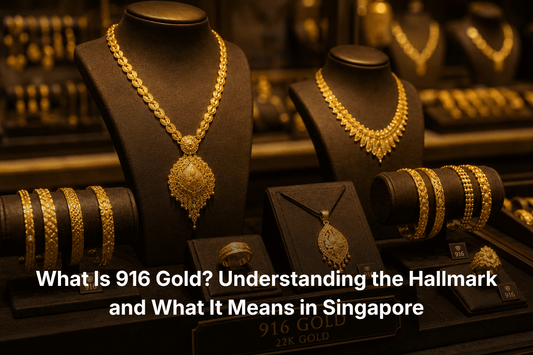
916 has held its place as the standard for most traditional Singapore jewellery because it balances high gold content with enough durability for regular wear, which is also why it carries strong cultural weight in gifting contexts across Chinese, Malay, and Indian communities.
750: Durability-Focused Pieces, Fine Diamond-Set Jewellery, and Everyday Wear Priorities
Buyers prioritising long-term durability over maximum gold content tend to land on 750, particularly for engagement rings, fine-set jewellery, or pieces expected to endure years of daily wear without frequent maintenance.
|
Purity |
Gold Content |
Matches This Purpose |
|
999 (24K) |
99.9% |
Investment bars, coins, storage-focused pieces |
|
916 (22K) |
91.6% |
Traditional jewellery, regular wear, cultural gifting |
|
750 (18K) |
75% |
Fine diamond-set jewellery, daily-wear durability |
The Trade-Offs Worth Weighing Before You Decide
Cost Per Gram Versus Long-Term Durability Savings
A higher-purity piece generally costs more per gram, but if a lower-purity piece needs repair or replacement sooner, that initial saving can disappear over time. The right trade-off depends on how long the piece is expected to last in active use.
Resale and Cultural Expectations Tied to Specific Purities
916 carries particular resale familiarity and cultural expectation in Singapore's traditional gold market, which can matter if resale or passing the piece down is part of the plan, separate from its raw gold value.
Why a "Higher Number" Isn't Automatically the Better Choice for Every Purpose
Choosing 999 for an everyday ring, or 750 for an investment piece meant to be stored untouched, misapplies each purity's strengths. The number that sounds most premium isn't necessarily the one suited to the specific purpose at hand.

A Practical Way to Decide Which Purity Fits Your Purchase
Questions to Ask Before Choosing a Purity: Purpose, Frequency of Wear, Budget, Cultural Context
Is this piece meant to be worn daily, occasionally, or stored as an asset? Does the occasion carry specific cultural expectations around purity? Is durability or maximum gold content the higher priority? Answering these honestly narrows the choice considerably before price even enters the conversation.
How to Confirm Purity Is Accurately Represented Before Buying
In Singapore, hallmarking through the Singapore Assay Office provides independent verification of a piece's stated purity. The office uses fire assay and X-ray fluorescence testing, checked against the national standard for precious metal fineness. This hallmarking is voluntary rather than mandatory, which makes checking for it, rather than assuming it, an important step for any buyer. A licensed jeweller such as G&M Collections would typically provide clear hallmark documentation confirming the purity stated on a piece.
When It's Worth Asking a Jeweller Directly Rather Than Guessing From the Label Alone
If a piece's intended purpose sits between two purities, a daily-wear piece with sentimental or cultural weight, for instance, asking a jeweller directly about durability expectations and hallmark verification is more reliable than assuming based on the label alone.
Conclusion
999, 916, and 750 gold each solve a different problem rather than sitting on a simple ladder from worse to better. 999 suits storage and investment, 916 balances tradition with practicality, and 750 prioritises durability for daily wear. The right choice comes down to matching the purity to the purpose, how the piece will be worn, gifted, or held, rather than defaulting to whichever number feels most familiar or premium. Once that framework is clear, choosing a purity becomes a considered decision rather than a habit.
Tags:
Previous
How to Clean Gold Jewellery at Home: The Safe Method and What to Avoid
Next
How Gold Jewellery Is Priced in Singapore: Making Charges, Wastage and Weight Explained
Related articles



-
May 22 2026
Is Buying Gold Jewellery a Good Investment in Singapore?

-
May 12 2026